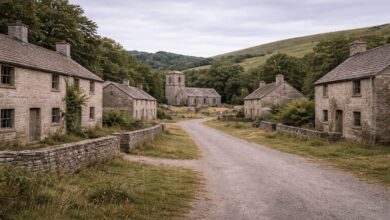
High above the Owens Valley, in the rugged Inyo Mountains of California, the abandoned mining town of Cerro Gordo clings to a narrow ridge. Weathered wooden buildings face open sky. Steep drop offs surround the settlement. Roads arrive reluctantly and leave quickly. Cerro Gordo was never an easy place to live, and it was never meant to be gentle. Its haunted reputation did not emerge from myth alone, but from geography, isolation, and a pattern of repeated loss that shaped daily life for decades.
What remains today is not simply a ghost town, but a place where environment and history combined to intensify absence. Structures still stand, yet the conditions that once made survival possible are gone. Silence here feels earned.
A town built at the edge
Cerro Gordo was established in the mid nineteenth century after rich silver deposits were discovered in the mountains east of the Sierra Nevada. The location was extreme by necessity. Ore dictated placement, not comfort.
Buildings were erected on narrow ledges. Streets followed topography rather than plan. Every structure acknowledged risk. From the beginning, the town existed at the edge of practicality. Similar human responses to silence and environment can also be observed in the settlement of Silver City.
Isolation as a constant condition
Access to Cerro Gordo was always difficult. Supplies traveled long distances by mule and wagon. Winters were severe. Communication with surrounding settlements was limited.
Isolation shaped social dynamics. Residents depended heavily on one another, yet lived with constant awareness that help was far away.
Distance magnified consequence.
Violence and instability in boom years
During its peak, Cerro Gordo was productive and profitable, but far from orderly. Mining wealth attracted transient populations, disputes, and crime.
Historical accounts describe frequent violence and sudden deaths. Law enforcement was inconsistent. Justice was informal and often brutal.
Instability became normalized.
Loss layered over time
Beyond violence, Cerro Gordo experienced repeated accidents, illnesses, and environmental hardship. Mining itself carried constant risk. Exposure, falls, and equipment failures were common.
Loss was not singular. It accumulated.
Over time, the town developed a collective familiarity with death that reshaped how space was perceived.
Architecture shaped by urgency
Buildings in Cerro Gordo were constructed quickly and pragmatically. Wood was favored for speed. Foundations adapted to uneven ground.
The result was a town that felt provisional even at its height. Structures were meant to function, not endure.
That provisional quality remains visible today.
Decline without relief
As ore production declined, Cerro Gordo’s isolation became less tolerable. Investment slowed. Residents left in waves.
There was no alternate economy to soften the transition. When mining ceased, purpose vanished.
Departure accelerated absence.
Buildings that refuse to disappear
Despite decline, many of Cerro Gordo’s buildings remain standing. The American Hotel, residential cabins, and mining structures still define the settlement.
Dry desert air slowed decay. Elevation limited vegetation.
Preservation occurred by environment, not intention.
Why the town feels watched
Visitors often describe a sensation of being watched at Cerro Gordo. This perception is not rooted in narrative alone.
Buildings sit on exposed slopes with commanding sightlines. Windows face open ground. Paths funnel movement predictably.
Design creates awareness.
Silence shaped by exposure
Unlike enclosed abandoned towns, Cerro Gordo is open to wind and sky. Sound carries unevenly. Silence is punctuated by movement of air rather than walls.
This openness heightens vulnerability.
The environment remains active even when the town is not.
Haunted reputation as accumulation
Cerro Gordo’s haunted reputation did not arise from a single story. It developed through repetition. Isolation. Violence. Accidents. Loss.
Over time, these experiences hardened into identity.
Reputation followed pattern, not invention.
Comparison with other mining towns
Many mining towns collapsed quietly. Cerro Gordo collapsed under pressure that was already intense.
Its decline did not remove danger. It exposed it.
The town feels harsher because it always was.
The role of landscape
The surrounding landscape is vast and indifferent. Mountains dominate scale. Valleys drop away sharply.
Human presence here always felt temporary against geological permanence.
That imbalance remains visible.
Ethical restraint and clarity
Cerro Gordo’s reputation often invites sensational framing. Responsible interpretation emphasizes historical conditions rather than exaggeration.
The town’s atmosphere can be explained without myth.
Context strengthens understanding.
Memory embedded in hardship
Cerro Gordo remembers hardship through layout and condition. Narrow paths, precarious buildings, and exposed ridges speak clearly.
The town communicates effort more than comfort.
Effort lingers.
Time without softening
Time has weathered surfaces but has not softened edges. The town remains sharp, both physically and perceptually.
Decay did not romanticize Cerro Gordo.
It clarified it.
Presence defined by exposure
Any sense of presence at Cerro Gordo arises from exposure. There is nowhere to hide. Structures are visible from most angles.
Visibility creates awareness.
Awareness becomes unease.
A town that never relaxed
Even in its most prosperous years, Cerro Gordo was tense. Survival required attention. Relaxation was rare.
That tension did not leave with the population.
It remains embedded in place.
Why Cerro Gordo still matters
Cerro Gordo matters because it shows how reputation can emerge organically from lived experience rather than legend. It demonstrates how isolation and repeated loss can shape collective memory.
The town is not mysterious. It is instructive.
Hard places leave hard impressions.
Between ambition and endurance
Cerro Gordo was built from ambition, sustained by endurance, and abandoned when endurance failed.
What remains reflects all three stages.
The town holds them simultaneously.
A settlement defined by strain
Cerro Gordo’s identity is strain without relief. Structures remain upright, but nothing here feels settled.
The town stands as it lived, uneasy.
Enduring Perspective
Cerro Gordo endures as a high desert mining town where isolation, loss, and repeated incidents hardened into a haunted reputation grounded in reality rather than myth. Its power lies in exposure. Nothing shields the town from environment or history.
On a narrow ridge above the Owens Valley, Cerro Gordo remains a place where absence feels alert rather than empty. Buildings stand as they always did, facing open land and wide sky, holding the memory of lives shaped by danger, distance, and endurance. Here, silence does not calm. It watches. Related reflections on memory and perception can also be found in life at Wrangell–St. Elias Edge.
Horizon Report documents places shaped by memory, infrastructure, and human decisions. Our editorial approach focuses on what remains physically visible, how abandonment unfolds over time, and how interpretation is clearly separated from observable evidence.
For readers seeking deeper context, the following background articles explore how ghost towns emerge, why communities are left behind, and why preservation matters in understanding collective history.
- Abandonment And Ghost Towns
- What Is A Ghost Town
- Why Towns Are Abandoned
- Preserving Abandoned Places
Editorial transparency matters. Observations are grounded in site layout, materials, remaining structures, and documented timelines where available. Interpretive layers are presented as interpretation, not assertion.
Careful readers often notice details worth refining. Thoughtful feedback helps ensure accuracy, clarity, and long term editorial integrity.